
Fleet fuel management is the practice of controlling and optimizing all the fuel and energy a fleet consumes, across fuel cards, onsite tanks, and EV charging, by capturing every transaction, attributing it to a vehicle, catching fraud and waste, and driving down cost per mile. It is usually the first place a fleet looks for savings, because fuel and energy is the largest controllable cost in the budget.
What fleet fuel management covers
- Data capture: pulling in fuel card, onsite tank, and EV charging transactions automatically.
- Reconciliation: matching each transaction to the vehicle and driver behind it.
- Fraud and waste detection: flagging fills that do not fit the vehicle, route, or tank.
- Controls: card limits, product restrictions, and alerts tuned to how the fleet actually operates.
- Reporting: cost per vehicle, cost per mile, and consumption trends the whole team can see.
It covers every source of fuel and energy, not just the fuel card: retail fills on one or more cards, diesel drawn from a yard tank, DEF or AdBlue, and EV charging at the depot, at home and on the road. A program that only watches one card sees only part of the spend.
Why it matters
Without active fuel management, spend is taken on trust: a card statement shows what was bought, not whether it was legitimate. Good fuel management turns that statement into verified, per-vehicle cost, which is the foundation of total cost of ownership.
The amounts are large. ATRI's 2026 operational cost report puts fuel at about 48 cents per mile for a US Class 8 truck in 2025, out of a total operating cost of $2.336 per mile. On a truck running 100,000 miles a year, that is roughly $48,000 of fuel. A leak of a few percent, from fraud, idling or unrecorded tank draws, costs more than most fleets spend on their fuel software.
The metrics that matter
You cannot manage what you do not measure. Five numbers do most of the work:
- Fuel economy: miles per gallon in the US, or litres per 100 km (or mpg) in the UK, per vehicle and per vehicle type. A vehicle drifting away from its peers is the earliest sign of a mechanical fault, a driving habit, or misuse. See fleet fuel economy.
- Fuel cost per mile: fuel and energy spend divided by miles driven. The number that lets you compare vehicles, routes and fuel types fairly. See fleet cost per mile.
- Spend per vehicle, from every source: cards, tank draws and charging added together. A vehicle that fills half from the yard and half on a card looks normal in each system and only shows a problem when you add them up.
- Idle fuel: fuel burned with the engine running and the vehicle going nowhere. It is pure cost, and telematics already records it. See fleet idling costs.
- Exceptions: the share of transactions that fail a check, and how quickly each one is reviewed. A falling exception rate is the clearest proof the program is working.
How to set up a fleet fuel management program
- List every fuel source. Every card program, every onsite tank, every charge point, and any off-card purchases on personal cards or expenses. Most fleets find at least one source nobody was watching.
- Connect the data. Get transactions out of each source automatically, not as a monthly export. Then connect telematics, because location, mileage and fuel level are what make a transaction checkable.
- Map cards and fuel sources to vehicles. Keep the history: a card moved from one vehicle to another in March means transactions before and after belong to different vehicles. Getting this wrong is the most common reason fuel reports do not add up.
- Set card controls. Product restrictions, transaction volume caps just above tank capacity, and time limits where the operation genuinely does not run. See fuel card spend controls that work.
- Audit every transaction. Check each fill against where the vehicle was, how much its tank could take, how much its fuel level rose, and what fuel it uses. Review the exceptions weekly at least, daily if you can.
- Report and act. Share cost per vehicle and cost per mile with operations and finance every month, coach the drivers behind repeat exceptions, and fix the vehicles whose fuel economy is drifting.
Card controls vs auditing
Fuel card controls and fuel auditing do different jobs, and most fleets need both.
Card controls work at the pump, before the sale. They stop purchases that break the rules you set: the wrong product, over a limit, outside allowed hours. What they cannot do is see the vehicle. A fill that passes every prompt still goes through if the truck was 40 miles away or the gallons exceed its tank.
Auditing works after the sale, on every transaction. It checks each fill against what the vehicle actually did, using telematics. It catches what controls miss: cloned cards, personal fill-ups, one card shared across vehicles, and fuel paid for that never reached the tank. Read more in what is fuel card fraud.
Fuel cards vs telematics vs fuel management software
Fleets often ask whether they already have fuel management because they have a fuel card and a telematics system. Each covers part of the job:
| Fuel card portal | Telematics | Fuel management software | |
|---|---|---|---|
| What it sees | Purchases on that card | Location, mileage, fuel level, idling | Every card, tank and charge point, plus telematics |
| Controls at the pump | Yes | No | No, works alongside card controls |
| Checks each fill against the vehicle | No | Only if card data is matched in | Yes |
| Onsite tanks and EV charging | No | No | Yes |
| Cost per vehicle from all sources | No | No | Yes |
A fuel card controls spend on that card. Telematics knows what the vehicle did. Fuel management software joins the two, across every source, so each transaction can be checked.
Manual vs software
Many fleets still manage fuel in spreadsheets, exporting a card report and reconciling by hand once a month. It works, barely, but it is slow, backward-looking, and misses the fills that do not reconcile. Dedicated fuel management software captures the data continuously and checks it automatically.
How does fleet fuel management software work?
It works in four steps:
- Collect: it takes in transactions from your fuel cards, onsite tank systems and charge points, plus location, mileage and fuel level from your telematics.
- Match: it attributes each transaction to a vehicle and driver, using card-to-vehicle history.
- Check: it tests every fill against the vehicle: was it at the station at that time, does the volume fit the tank, did the fuel level rise by the amount bought, is it the right fuel. Fills that fail are flagged with the detail behind them.
- Report: it rolls the verified transactions into fuel economy, cost per mile and cost per vehicle across every source.
#1 AI-powered fleet spend control platform
Ready to Stop Losing Money on Fleet Spend?
See how much you could save in the first week. Start your free trial today. Cancel anytime.
How Fleevo does fleet fuel management
Fleevo connects your fuel cards, onsite tanks, EV charging, and telematics into one platform. It works with the cards you already run, including WEX, Voyager, EFS, Shell, BP, Allstar and Keyfuels, onsite tank systems such as FuelCloud, and telematics from Samsara, Geotab and Verizon Connect, which are official partners. You do not need to switch card programs or add hardware.
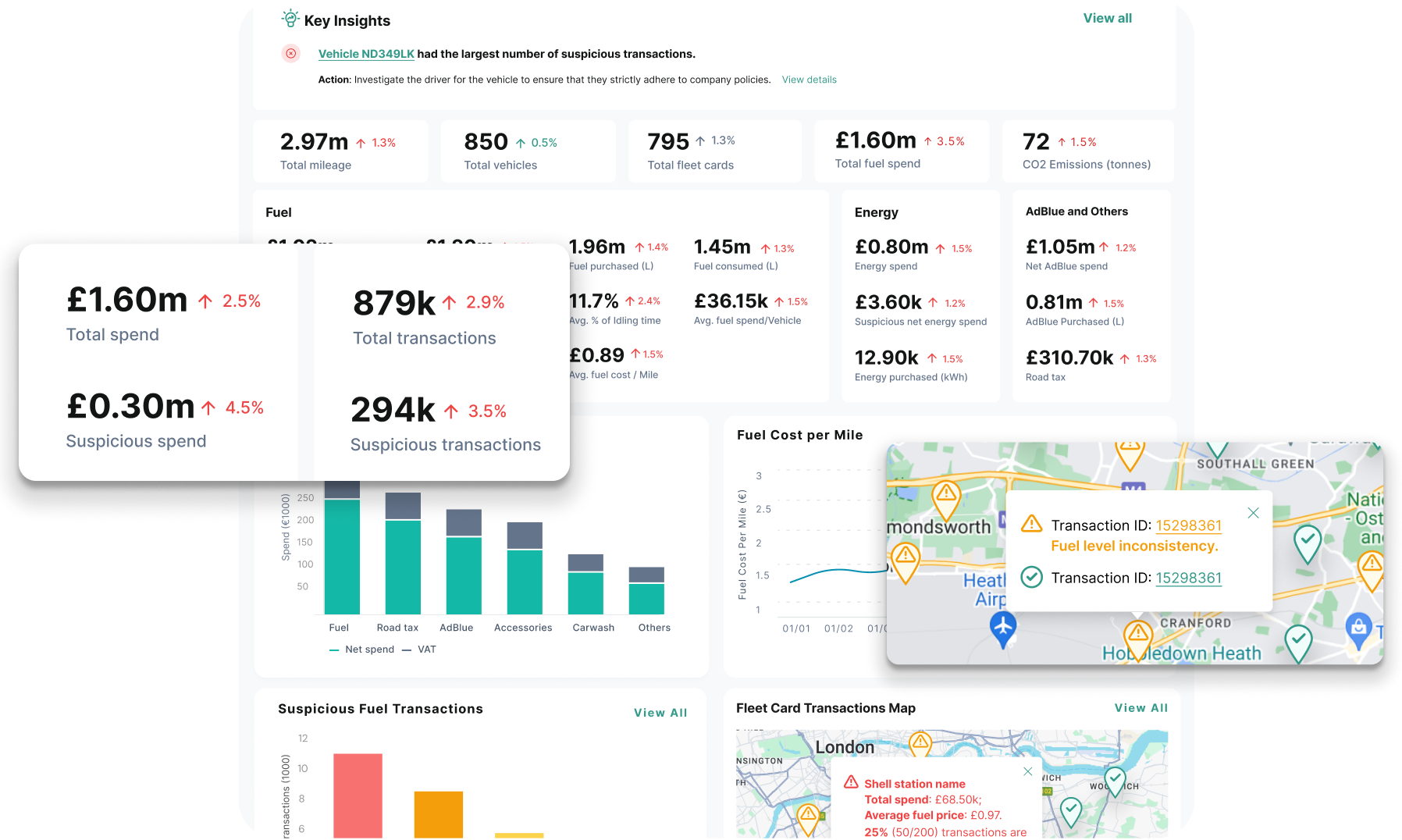
Every transaction is checked against the vehicle's location, tank capacity, fuel level and fuel type, and you can add your own checks in plain English, such as "flag a second fill within an hour." DEF and AdBlue purchases and idle cost per vehicle sit in the same view, so fuel economy and cost per mile reflect every source. Compare the market in the best fuel management software for fleets, or explore Fleevo's fleet fuel management software. Fleevo offers a free 3-month fuel audit, with the number back within 48 hours.
Fleet fuel management FAQs
What is fleet fuel management?
Controlling and optimizing all the fuel and energy a fleet uses, across cards, tanks and EV charging, by capturing every transaction, attributing it to a vehicle, and catching fraud and waste.
What is the goal of fuel management?
To make every unit of fuel accountable: verified against the vehicle, free of fraud and waste, and rolled into an accurate cost per mile.
Do I need fuel management software?
Any fleet can manage fuel in spreadsheets, but software is what makes continuous reconciliation and fraud detection practical at scale.
Can fleet fuel management systems integrate with telematics?
Yes, and they should. Telematics provides the location, mileage and fuel level that let each transaction be checked against what the vehicle actually did. Fleevo connects to Samsara, Geotab, Verizon Connect and other telematics systems.
How does fleet fuel management software work?
It collects transactions from your cards, tanks and charge points, matches each one to a vehicle, checks it against telematics for location, tank capacity, fuel level and fuel type, and reports cost per vehicle and cost per mile from the verified data.
What should a fleet fuel management system cover for a mixed fleet?
Every fuel type and source: diesel and gasoline on any card, onsite tank draws, DEF or AdBlue, and EV charging. Choose one that works with the cards and telematics you already have, so vans, trucks and EVs sit in one view.
What fuel management solutions are easiest to set up?
Ones that connect to the fuel cards and telematics you already use, with no new cards or hardware. Most Fleevo customers are live within 48 hours.
Related: what is fuel card fraud, fleet fuel reconciliation, onsite fuel tank reconciliation, EV charging cost management, fuel slippage, and best fuel management software.
Sources
- ATRI, An Analysis of the Operational Costs of Trucking: 2026 Update: truckingresearch.org
- FleetOwner, cost per mile by expense category: fleetowner.com