
A fuel card policy is the written set of rules for who can use a company fuel card, what it can buy, and what happens when it is misused. Most fuel card misuse is not sophisticated. It is opportunistic, and it thrives where the rules are vague. Detection catches fraud after the money has gone; a clear policy stops much of it from happening at all. It is the cheapest fraud control a fleet has, and the most often neglected.
Below is a fuel card policy template you can copy and adapt, followed by what each section needs to get right.
What a fuel card policy should include
- Purpose and scope: who the policy covers, including employees, agency drivers and contractors.
- Card assignment: one card per vehicle or per named driver, never a shared card.
- PINs and driver ID: how PINs are issued and kept secret.
- Approved purchases: which fuel types, sites and extras are allowed.
- Limits: spend, volume and time limits per card.
- At the pump: odometer entry, receipts and filling only the assigned vehicle.
- Lost or stolen cards: who to call and how fast.
- Monitoring: that every transaction is checked.
- Misuse and consequences: what counts as misuse and what happens next.
- Acknowledgement: the driver's signature.
Fuel card policy template
Copy the template below, replace the text in square brackets, and check it with HR before issuing it.
1. Purpose
This policy sets out how [Company] fuel cards are issued, used and monitored. It applies to every employee, agency driver and contractor who holds or uses a [Company] fuel card.
2. Card assignment
- Each card is assigned to one vehicle, [registration], or one named driver.
- Cards must not be lent to, shared with, or used by anyone else.
- Cards stay with the assigned vehicle or driver. When a vehicle or driver changes, the card is returned to [fleet manager] and reassigned.
3. PINs
- Each driver receives a personal PIN. Never write it on the card or share it.
- If you think someone knows your PIN, tell [fleet manager] the same day.
4. Approved purchases
- The card may be used only for [diesel / petrol / gasoline / AdBlue / DEF / EV charging] for the assigned vehicle.
- [Shop purchases, car washes and oil are / are not] allowed. [Any exceptions.]
- Use [approved networks or sites] where possible.
- Fuel for personal vehicles, personal journeys, jerry cans or other equipment is not allowed unless [fleet manager] approves it in writing.
5. Limits
- Each card has a limit of [X litres or gallons] per transaction, [Y transactions] per day and [£ or $ amount] per [week or month].
- The card works only [between set hours / on working days].
- Requests for a higher limit go to [fleet manager] in writing.
6. At the pump
- Fill only the vehicle the card is assigned to.
- Enter the vehicle's current odometer reading accurately at every fill.
- Keep the receipt and submit it [how and when].
7. Lost or stolen cards
- Report a lost or stolen card to [fleet manager or card provider number] immediately, and within [2] hours at most.
- You may be liable for transactions after the loss if you delay reporting it.
8. Monitoring
- Every transaction is checked against the vehicle's location, tank capacity, fuel type and mileage.
- Transactions that do not match will be raised with you and may be investigated.
9. Misuse
Misuse includes: fuelling a vehicle other than the assigned one, personal purchases, sharing a card or PIN, splitting transactions to avoid a limit, false odometer entries, and failing to report a lost card. Misuse is a disciplinary matter. [Company] may recover the cost from your pay [where your contract allows] and may dismiss you for gross misconduct. Suspected fraud may be reported to the police.
10. Acknowledgement
I have read and understood the [Company] fuel card policy and agree to follow it.
Name: ______ Signature: ______ Date: ______ Card or vehicle: ______
How to make each section work
Card assignment. This is the rule every other control depends on. Shared and float cards are the single biggest source of untraceable spend, because they break the link between a transaction and a person. If you must keep spare cards for pool vehicles, log who takes each one, and when. See our guide to fuel card sharing.
PINs. Use a unique PIN per driver where the provider supports it, rather than one PIN per card. A driver PIN tells you who filled up, not just which card was used.
Limits. Set the volume limit just above the tank capacity of the vehicle the card is for, not one fleet-wide figure. A van card with an HGV-sized limit is an open invitation. See fuel card spend controls that work.
Odometer entry. Require it, but do not rely on it alone. Drivers make typing mistakes, and some make deliberate ones. Mileage from telematics is the reliable reference for checking a fill.
Personal use and tax. Say clearly whether private fuel is ever allowed. In the UK, fuel for private journeys paid for by the employer can create a car fuel benefit charge for the driver. In the US, personal use of a company vehicle is generally a taxable fringe benefit. Check with your accountant before allowing it.
Consequences. A policy without consequences is a suggestion. State them, apply them consistently, and tell drivers that transactions are monitored. A policy drivers know is enforced prevents far more than one that sits in a drawer.
Rolling the policy out
- Agree it with HR, so the disciplinary and cost-recovery clauses match employment contracts.
- Brief drivers, in person or at a toolbox talk, not just by email.
- Collect signatures before issuing or reissuing cards.
- Set the card controls to match the policy at the card provider.
- Monitor and review. Check transactions against the policy every week, and review the policy once a year or after any fraud case. Our fuel card audit checklist covers what to look for.
#1 AI-powered fleet spend control platform
Ready to Stop Losing Money on Fleet Spend?
See how much you could save in the first week. Start your free trial today. Cancel anytime.
How Fleevo enforces your fuel card policy
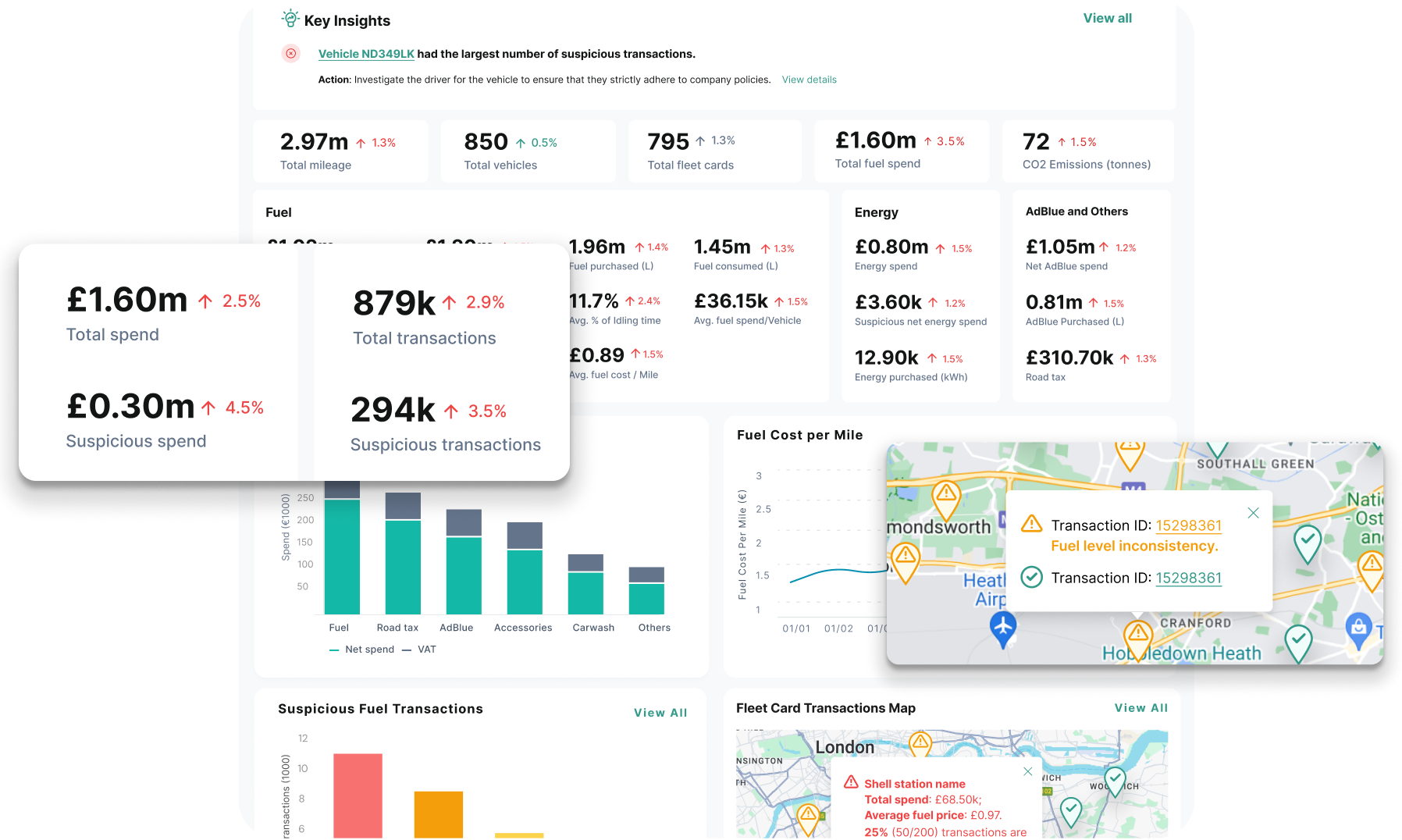
A policy is only as good as the monitoring behind it. Fleevo checks every transaction against the vehicle it is assigned to, using your telematics: was the vehicle at the site, does the volume fit its tank, did its fuel level rise, and is it the right fuel. It flags card sharing, odd volumes, out-of-hours fills and out-of-pattern purchases, and you can add your own rules in plain English, such as "flag a second fill within an hour." That way the rules in your policy are checked on every fill, across every fuel card you use. Explore Fuel and EV Charge Management, or read what fuel card fraud is and how to prevent it.
Fuel card policy FAQs
What should a company fuel card policy include?
Card assignment, PIN rules, approved purchases, spend and volume limits, odometer and receipt rules, how to report a lost card, monitoring, what counts as misuse and its consequences, and a signed acknowledgement.
Is there a free fuel card policy template?
Yes, the template above. Copy it, fill in the square brackets for your company, and check the disciplinary clauses with HR.
Why is one card per vehicle or driver so important?
Shared cards break the link between a transaction and a person, which makes fraud untraceable and gives misuse an easy excuse.
Can employees use a company fuel card for personal fuel?
Only if the policy allows it. Most policies ban it. Where it is allowed, it can have tax consequences for the driver, so take advice first.
What happens if a driver misuses a fuel card?
Whatever the policy says. Typically a disciplinary process, recovery of the cost where the contract allows, and dismissal or a police report for deliberate fraud.
Does a fuel card policy actually reduce fraud?
Yes, when it is specific, signed and enforced with monitoring. A policy nobody checks against the data has little effect.
Related: fuel card sharing, fuel card spend controls, fuel card audit checklist, and fuel card skimming.
This template is general guidance, not legal advice. Check it against your employment contracts.