
Fleet fuel economy is how far your vehicles travel on each unit of fuel, measured in miles per gallon (MPG) or litres per 100 kilometres (L/100km). Tracked per vehicle, it is one of the earliest signals that something has changed: a mechanical fault, a driving habit, a new route, or a fuel transaction that never belonged to that vehicle. And because fuel is usually the largest controllable cost in a fleet budget, every point of fleet fuel efficiency gained goes straight to cost per mile.
This guide covers how to measure fleet fuel economy properly, the mistakes that distort it, and the levers that improve it.
How to calculate fleet MPG
For one vehicle:
- MPG = miles driven ÷ gallons used
- L/100km = litres used ÷ kilometres driven × 100
For the whole fleet, or a group of vehicles, add up first and divide once: total miles driven by all vehicles, divided by total gallons used. Do not average each vehicle's MPG. A van that did 200 miles at 40 MPG would count the same as a truck that did 20,000 miles at 7 MPG, and the result would be meaningless.
Use a period long enough to smooth out timing, at least a month. A single fill is a poor measure, because drivers rarely fill to exactly the same level each time. One fill looks like 25 MPG, the next like 12, and neither is true. Monthly totals of distance and fuel give a stable number.
A note on units
MPG is not one number. A US gallon is 3.785 litres and a UK (imperial) gallon is 4.546 litres, so the same vehicle shows a lower MPG in US units. To convert:
| From | To | Calculation |
|---|---|---|
| US MPG | UK MPG | × 1.201 |
| UK MPG | US MPG | × 0.833 |
| US MPG | L/100km | 235.2 ÷ US MPG |
| UK MPG | L/100km | 282.5 ÷ UK MPG |
With L/100km, a lower number is better. If your fleet runs in more than one country, or mixes fuel types and EVs, cost per mile is the fairest single measure. See fleet cost per mile.
Where the data should come from
Fuel economy is only as good as its two inputs: distance and fuel.
- Distance from telematics, not the pump. The odometer a driver types in at the pump is useful as a reference, but it is full of typing mistakes and the occasional made-up number. Telematics records distance automatically.
- Fuel from every source. Fuel card transactions, onsite tank draws and any fills paid on expenses. A vehicle that fills half from the yard tank and half on a card looks twice as efficient as it is if you only count the card.
- Every fill against the right vehicle. A card moved from one vehicle to another, or a fill logged against the wrong registration, instantly distorts both vehicles' MPG.
Real-world vs official figures
Manufacturer figures come from standardized lab tests and rarely match fleet use, especially for vehicles that carry loads, idle at sites, or do stop-start urban work. Benchmark each vehicle against its own history and against peers of the same make, model and duty, not against the brochure.
How to improve fleet fuel efficiency
Driving style. The biggest lever most fleets have. The US Department of Energy says aggressive driving, meaning speeding and hard acceleration and braking, can lower gas mileage by roughly 15% to 30% at highway speeds and 10% to 40% in stop-and-go traffic. Telematics already scores harsh events per driver, so coach the worst first.
Speed. According to the Department of Energy, gas mileage usually falls rapidly above 50 mph. Speed limiters or a clear policy on top speed pay back quickly on highway-heavy routes.
Idling. An idling engine gets zero MPG. The Department of Energy puts idling at a quarter to a half gallon an hour for a passenger vehicle, and its Alternative Fuels Data Center puts a heavy-duty truck at about 0.8 gallons an hour. Idle time is recorded by telematics, so it can be measured and costed per vehicle. See fleet idling costs.
Tire pressure. The Department of Energy says keeping tires at the correct pressure improves gas mileage by about 0.6% on average, and up to 3% in some cases. It is small per vehicle but free, and it improves safety and tire life too.
Weight. An extra 100 pounds can cut MPG by about 1%, according to the Department of Energy, with a bigger effect on smaller vehicles. Clear out tools and stock that ride around unused.
Maintenance. Clogged filters, worn injectors and dragging brakes all cost fuel. A vehicle whose MPG drifts down while its routes stay the same is often due a service. See the fleet preventive maintenance checklist.
Routing and vehicle choice. Fewer miles beat better miles. Plan routes to cut empty running, and match vehicle size to the job: a large van doing small-van work burns fuel for nothing.
How to spot a vehicle that is drifting
- Group like with like: same make, model and type of work.
- Calculate each vehicle's monthly MPG from telematics distance and all fuel sources.
- Compare each vehicle with its group, and with its own last three months.
- Investigate the outliers. A vehicle well below its peers is either using more fuel, through a fault, a driving habit or heavy idling, or being charged for fuel it never received.
That last point matters. A sudden fall in a vehicle's fuel economy is one of the clearest signs of fuel card fraud: fills for a personal car, a shared card, or a cloned card all show up as fuel the vehicle could not have used.
#1 AI-powered fleet spend control platform
Ready to Stop Losing Money on Fleet Spend?
See how much you could save in the first week. Start your free trial today. Cancel anytime.
How Fleevo measures fleet fuel economy
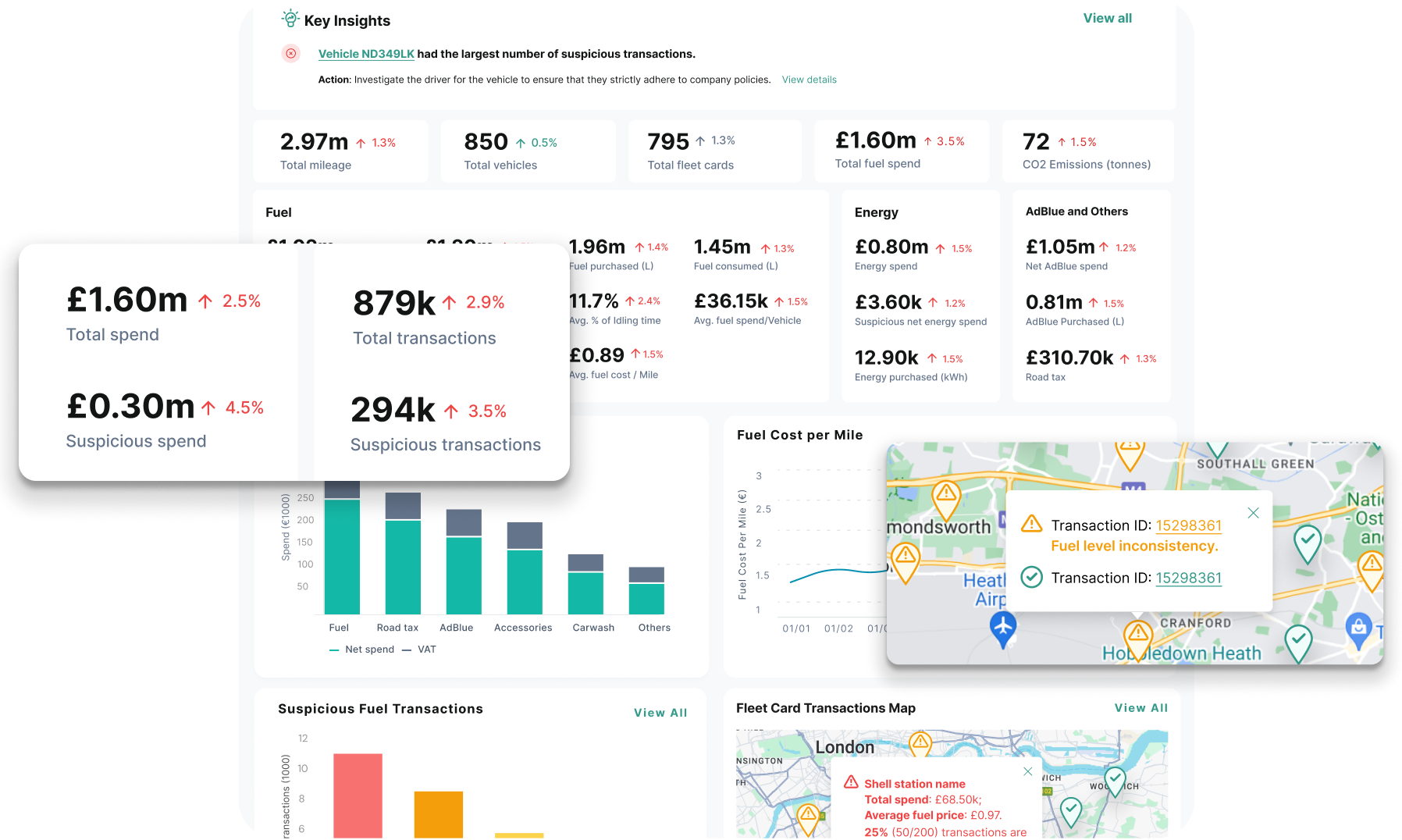
Fleevo calculates fuel economy per vehicle from telematics distance and reconciled fuel from every fuel card and onsite tank, so the figure reflects what each vehicle actually used. Every fill is checked against the vehicle's location, tank capacity, fuel level and fuel type, so a poor MPG points either to a genuine efficiency problem or to a transaction that does not belong. Idle time and idle fuel cost per vehicle sit in the same view. Read what fleet fuel management covers, or explore Fuel and EV Charge Management.
Fleet fuel economy FAQs
How do you calculate fleet fuel economy?
Divide the total miles driven by all vehicles by the total gallons they used over the same period, at least a month. Do not average each vehicle's MPG.
What is the difference between fuel economy and fuel efficiency?
In fleet use they mean the same thing: distance per unit of fuel. Fuel consumption, such as L/100km, is the same measure turned around, where lower is better.
How can a fleet improve fuel efficiency?
Coach aggressive driving, cut speed and idling, keep tires at the right pressure, remove unneeded weight, keep vehicles serviced, and plan routes to reduce miles.
Why is my per-fill MPG so inconsistent?
Because drivers do not fill to the same level each time. Use monthly totals of distance and fuel instead of single fills.
Why do US and UK MPG figures differ?
A US gallon is smaller than a UK imperial gallon. Multiply US MPG by 1.201 to get UK MPG.
What causes a sudden drop in fuel economy?
A mechanical fault, a change in driving or route, more idling, or fuel wrongly charged to the vehicle, including fraud. Check the fills first, then the vehicle.
Related: fleet idling costs, fleet cost per mile, how to reduce fleet fuel costs, and what is fleet fuel management.
Sources
- US Department of Energy, fueleconomy.gov, Driving more efficiently: fueleconomy.gov
- US Department of Energy, Fuel economy tips consumer guide: energy.gov
- Alternative Fuels Data Center, heavy-duty vehicle idling fact sheet: afdc.energy.gov